
There is something about a ghost town that immediately makes a road trip more interesting.
Tell your kids you’re driving three hours to look at some old buildings, and you may get a reaction usually reserved for announcing that the Wi-Fi is down. Tell them you’re going to explore a ghost town and suddenly you’re searching for abandoned mines, buried treasure and, naturally, actual ghosts.
Oregon has plenty of places that fit the bill. Some are true abandoned communities. Others still have a handful of residents or enough life left that calling them “ghost towns” feels slightly rude. Either way, they’re fascinating places to introduce kids to Oregon history without asking them to quietly stare at something behind museum glass for two hours.
One important rule before you go: abandoned-looking does not mean abandoned. Many old buildings and surrounding lands remain private property. Stay on public roads and designated areas, don’t enter closed structures, and leave everything where you found it. Your child does not need a 120-year-old rusty nail as a souvenir.
Here are seven Oregon ghost towns and nearly vanished communities worth adding to a family road trip.
1. Shaniko
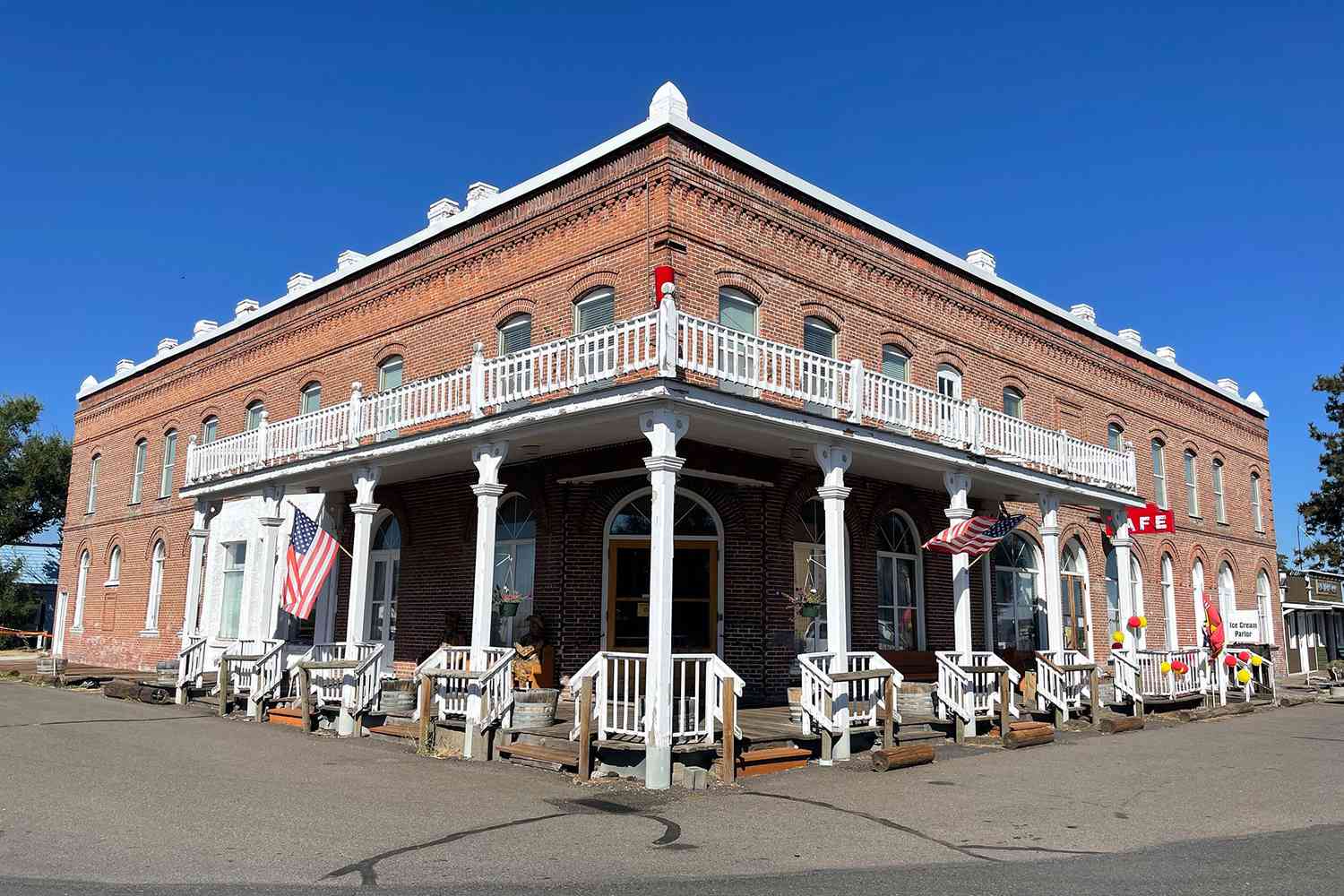
If your kids have a specific image in mind when they hear the words “ghost town,” Shaniko probably comes pretty close.
Located north of Madras along Highway 97, Shaniko exploded in the early 1900s thanks to the Columbia Southern Railroad and the wool industry. It became known as the “Wool Capital of the World,” with enormous amounts of wool, grain and livestock moving through town.
Then transportation routes changed, business moved elsewhere and Shaniko’s boom ended almost as quickly as it started.
Today, old storefronts and other historic buildings still give the town that classic Old West feeling. Shaniko isn’t completely abandoned, though. People still live there, and the historic Shaniko Hotel has even reopened after being closed for years.
For kids, that’s actually a plus. You get the fun of walking around what looks like a movie set without wondering whether your family has accidentally wandered into the opening scene of a horror movie.
2. Golden
If you want something closer to a genuine abandoned mining settlement, head south to Golden State Heritage Site near Wolf Creek.
Golden grew from an 1850s mining camp into a small community around 1890. At its peak, about 100 people lived there. Four historic structures remain today, including a church and a building that once housed the post office and store.
Golden also had an unusual distinction for a Western mining town: no saloon in the town center. It had two churches instead.
Apparently even in the 1890s there was one Oregon community that looked at the standard gold-town business model and said, “Maybe everybody could just calm down.”
Oregon State Parks manages the site, and it’s open for day use year-round. That makes Golden one of the easier ghost towns for families to explore without worrying that you’ve accidentally parked in someone’s backyard.
3. Sumpter
Sumpter isn’t completely abandoned either, but its mining history is so good that it belongs on the list.
Gold discoveries brought prospectors into the Blue Mountains and Sumpter Valley beginning in the 1860s.
The star attraction today is the enormous Sumpter Valley Gold Dredge, a giant floating mining machine that dug through the valley looking for tiny flakes of gold. The last dredge operated from 1935 until 1954 and recovered an estimated $4 million in gold during its lifetime.
Visitors can board the dredge during its operating season, and trails wind through the surrounding wetlands. It’s basically a gigantic rusty machine sitting in the middle of beautiful Eastern Oregon scenery, which means there’s a decent chance the kids will actually want to hear how it worked.
Just be prepared for the inevitable question: “Can we find gold?”
The technically correct answer is yes.
The more useful parental answer is: “Probably not enough to pay for this trip.”
4. Granite
Continue exploring Eastern Oregon and you’ll find Granite, another community built around gold.
Gold was discovered in the area in 1862, and Granite eventually developed the usual collection of hotels, stores, a post office and, unlike Golden, plenty of saloons.
As mining declined, so did the town. Only a small population remains today.
Granite feels much more remote than Shaniko, which is part of the appeal. This is a place where the drive itself becomes part of the adventure.
It’s also a good reminder that ghost-town trips require a little more preparation than driving to OMSI. Check road and weather conditions, fill up the gas tank, bring food and water, and don’t assume your phone will happily provide directions everywhere.
Travel Oregon recommends extra supplies and even a paper map when exploring Oregon’s more remote ghost towns.
Yes, an actual paper map.
Your children may need an explanation of this ancient technology.
5. Boyd and Friend
Families coming from Portland don’t necessarily have to cross half the state to get a taste of ghost-town country.
South of The Dalles, you can find the remnants of Boyd and Friend.
Boyd developed along Fifteenmile Creek during the late 1800s. Today, a few homes, outbuildings and an old grain elevator remain from a community that once had roughly 150 to 200 residents.
Continue through Dufur toward Friend, and you’ll find more pieces of Oregon’s rural past, including an old schoolhouse, cemetery and other remnants of the former community.
Friend once served farmers, sheepherders and loggers and sat at the end of the Great Southern Railroad line.
This is more of a “look, imagine and keep driving” ghost-town adventure than a full tourist attraction.
That’s not necessarily bad news for parents.
Sometimes 20 minutes of history is precisely the correct amount of history.
6. Buncom
Southern Oregon gives us another wonderfully named ghost town: Buncom.
The settlement began as a gold-mining camp in the 1850s near Sterling Creek and the Little Applegate River. It later became a hub for nearby ranches, although Buncom was never formally incorporated as a town.
Here’s where the history gets especially interesting.
The “ghost town” visitors see today consists of three 20th-century buildings, and two were actually moved there from farther downstream. The remaining structures stand on private land, but visitors can view the exteriors from appropriate public areas.
So yes, Buncom is a ghost town with an asterisk.
That’s actually a fun lesson for kids. History isn’t always as simple as “old town existed, everybody vanished, ghosts moved in.” Places change, buildings move, stories get preserved and sometimes the version we see today isn’t exactly what stood there 150 years ago.
7. Champoeg
For Portland-area families who would prefer their vanished town with paved trails, picnic areas and considerably less driving, Champoeg State Heritage Area may be the easiest adventure on this list.
Champoeg was once a thriving Willamette River community of about 200 people. It also played a major role in Oregon history, serving as the site of the 1843 vote that established Oregon’s first provisional government.
Then, in 1861, a massive flood swept the town away.
That’s right. The entire town essentially disappeared.
Today, families can walk or bike trails through the area, visit historical landmarks, picnic, watch for birds or play disc golf. Nearby historic sites help tell the story of the people who lived in the area before the flood changed everything.
For kids, Champoeg creates a different kind of ghost-town experience. There aren’t rows of abandoned buildings waiting around every corner. Instead, you stand where an entire community once existed and try to picture houses, stores and families going about their lives in a place that now looks completely different.
And then you play disc golf, because even history has its limits.
A Different Kind of Oregon Adventure
Oregon’s ghost towns aren’t amusement parks. There may not be gift shops, snack bars or conveniently placed bathrooms. In some places, there isn’t much more than an old building and a story.
That’s exactly what makes them fun.
Kids get to look at a weathered schoolhouse and imagine who sat inside it. They can see an old mining machine and try to understand how enormous it really is. They can stand where a town once existed and realize that Oregon hasn’t always looked the way it does today.
Just remember the basic ghost-town rules: respect private property, stay out of unsafe buildings, don’t take artifacts and prepare for remote roads.
As for seeing an actual ghost?
We can’t promise anything.
But if someone in the back seat suddenly announces they need a bathroom when you’re 40 miles from the nearest town, you’ll definitely hear some haunting sounds.

Tiffany Wilson is a 42-year-old stay-at-home mom from Tigard, Oregon, raising three kids—Sophie, Noah, and Riley. She’s a warm, hands-on parent who mixes daily routines with creative fun, whether it’s a backyard scavenger hunt or building a blanket fort in the living room.