
With August approaching, many parents are savoring the last few weeks of summer vacation while also preparing for the start of school. As an early childhood teacher, I often hear caregivers ask how they can help their child prepare in advance for the transition to school. Talking through the transition can be supportive for older children who can conceptualize the coming change. However, with young children, especially those who have never gone to school before, simply talking about school, drop-off, and emotions can be abstract and confusing.
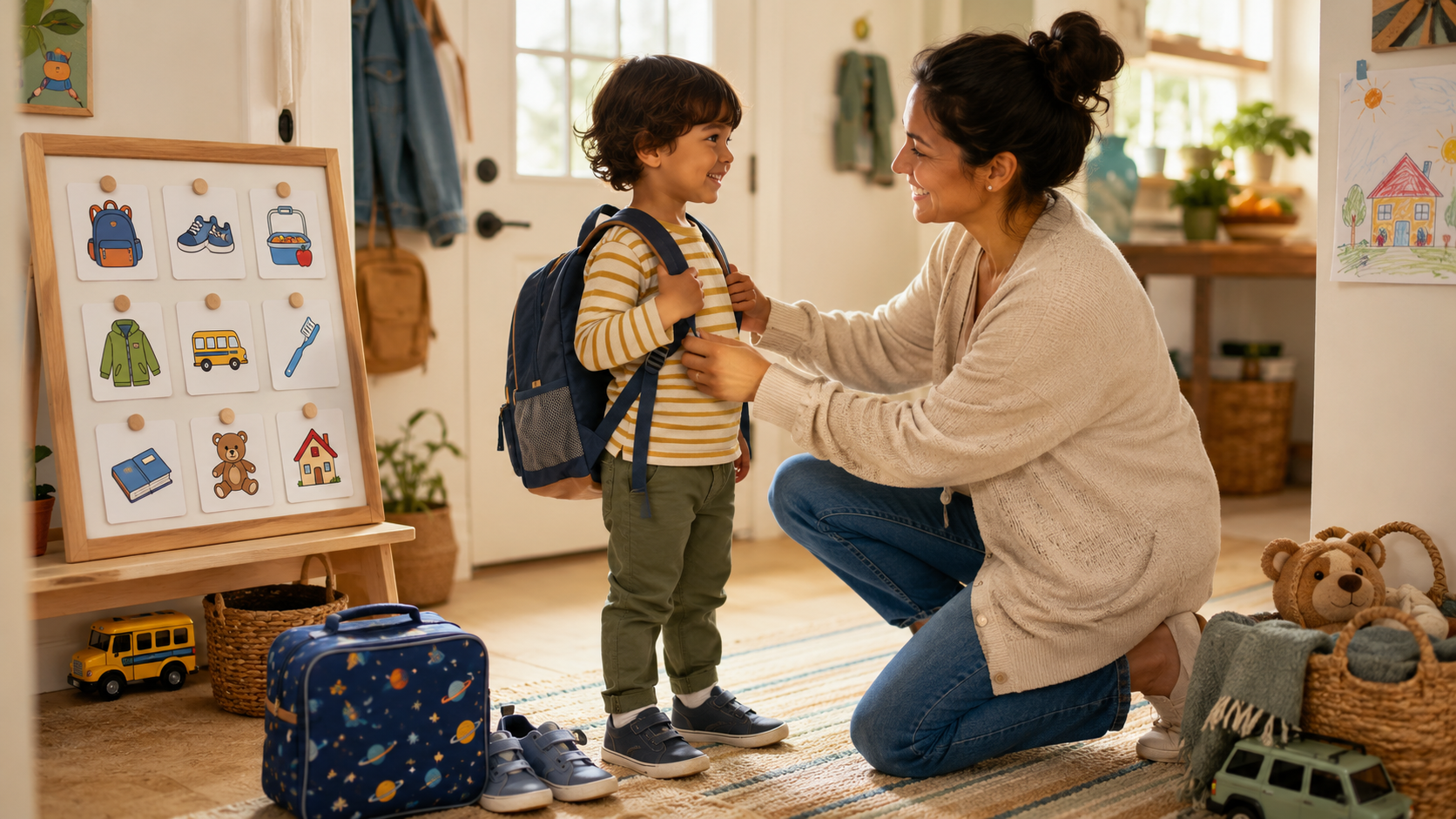
Instead, I suggest parents of young children use drama as a tool to prepare! Invent a game called the Get Ready for School game and set a goal to play it 2-3 times per week leading up to the first day. Tell your child that you’re going to pretend to get ready and go to school together. Then, playfully run through your routine as if it’s the morning and you are getting ready to head out the door. Parents often tell me that one of the hardest parts of routines like these is having to prompt their child to complete every step. I suggest creating a visual schedule routine to use while playing the game and once you’re truly getting ready for school. The schedule can include all the steps of your child’s morning process, up until the point that you say goodbye at school! You can also build in some agency by putting the schedule on a dry-erase surface that allows your child to check off each step once they complete it. Some common steps might be: get dressed, eat breakfast, brush your teeth, put your lunch in your backpack, put your shoes on, get in the car, etc. When you are playing the Get Ready for School game, rely on this schedule just as much as you will in the real scenario. If your child says, “Mom, what do I do next?” instead of immediately answering their question, playfully refer them back to their schedule by saying, “Check your steps!” This will support independence, foster a sense of capability, and build agency, helping your child approach the transition to school already feeling empowered.
Before playing Get Ready for School the first time, plan for how you will recreate the transition in the car or on the school bus. If you will be driving your child to school, I encourage you to load up in the car just as you will on a regular school day. While you certainly can drive all the way to the actual school, you don’t have to. You could do a loop around your block and arrive back at home, but pretend it’s the school. Similarly, if your child will be riding the bus, you can practice waiting at the bus stop near your house, and when the pretend bus arrives, sit in the grass nearby as if you’re in bus seats to reenact the ride. When the bus stops, unload and pretend you’re at school.
Think through what you would like your goodbye routine to look like before you act it out. While your child needs to have agency, it’s also true that most children (especially those with separation anxiety) need to know their adult is handling the goodbye process and that it will be predictable every time. When you are playing the Get Ready for School game, make a list of three ways to say goodbye. When it’s time, your child can choose one of the three ways; this gives them control over how goodbye is said but not necessarily when it is said. Some common choices I’ve seen parents use are: a special handshake, a short song, two kisses and a hug, or passing a special object like a note or stuffy that gets to stay with your child throughout the day. Embed these choices into the Get Ready for School game so that, by the time you’re at school on the first day, the choices feel second nature to both of you.
In addition to drama, it can also be helpful to read some books at home about feelings and the school transition. Powell’s carries many strong picture books addressing this topic. Many of these can also be put on hold at Multnomah County Library. Below are a few of my top recommendations for preschool- and kindergarten-aged children:
Mae’s First Day of School by Kate Berube
School’s First Day of School by Adam Rex
First Day Around the World by Ibi Zoboi
In My Heart by Jo Witek
Ruby Finds a Worry by Tom Percival
The Invisible String by Patrice Karst
It’s important to remember that, even with the best preparation, your child still may cry for a while at school drop-off. This is normal! Early childhood teachers are used to this and should communicate regularly with you about how your child’s transition is going in the first few weeks of school. The hardest, and most important, thing that you can do as a parent is to stay consistent. If you waver from the predictable goodbye routine you’ve set up with your child, it will heighten their anxiety. Even when your child is tearfully begging you to stay or pleading, “just one more hug,” it’s essential to reinforce that goodbye is predictable, they know what to expect, and the routine doesn’t falter. If you anticipate that this will be challenging for your child, communicate with their teacher ahead of time so that they can swoop in to soothe and support your child to engage after you leave.
And most importantly…be gentle with your child and yourself. This is a huge transition for both of you, and there are bound to be emotions and bumps along the way. Connect with other parents and know that you’re not alone in this transition and that it will get better with time and adjustment.