
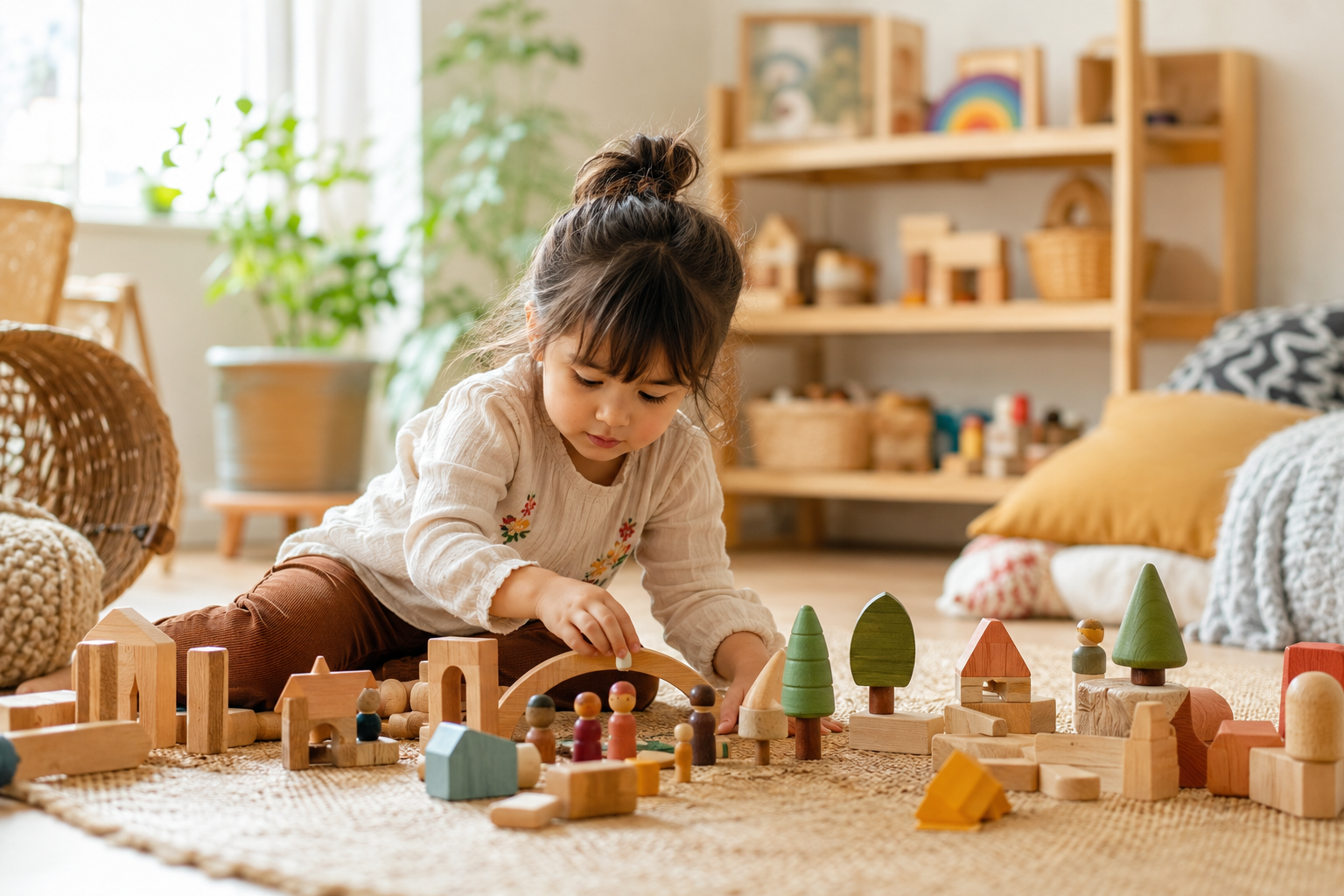
Do you recall a time when your child seemed wholly immersed in play? Perhaps they were embodying an imaginary character, building an idea with blocks, exploring water, pushing their personal boundaries by climbing high at one of our beautiful PDX playgrounds, gently caring for a baby doll, or narrating a story while they painted. Before reading any further, I encourage you to take a moment and reflect: What do you think it was about this specific play experience that engaged your child so deeply?
As an early childhood teacher, I spend much of the day observing children’s play and asking myself this question. Then I reflect on what I noticed. This process helps me decipher what the children are showing me they care about and decide what playful learning experiences to offer next.
As a caregiver, you can apply this same observation and reflection process at home. Observing your child’s play through this lens will allow you to thoughtfully offer activities and experiences specific to your child’s developmental stage that engage their unique interests and curiosities. To begin, try out the process below:
1). Observe
It’s so challenging for adults to thoughtfully observe children without directing, correcting, or intervening. When this happens unnecessarily, it alters the direction of the child’s play. I challenge you to sit quietly, a short distance away, and watch your child play. Only intervene if safety becomes an issue; otherwise, stay put and quietly notice. Here are some questions you might ask yourself while you watch:
- What story do I see my child playing out?
- How is my child being engaged sensorily, cognitively, socially, physically, and emotionally?
- What’s the environment like?
- Is my child using materials in their play? What are the materials adding to the play? (eg: materials could be…sticks, paint, building supplies, sand, dolls, etc.)
- Did anything unexpected, surprising, or challenging happen for your child while they played? How did they respond?
2). Reflect
There is depth to your child’s play even if, on the surface, it seems insignificant and silly. When children play they are often working out concepts, creating and exploring their own theories about the world, experimenting with power and boundaries, and mirroring adults in their lives. All of these (and more!) are key to child development. Here are some common themes you might observe:
- Role play: children often “try out” what they observe adults doing in the world. This might look like playing family, teacher, doctor, or mimicking adults’ work
- Big body play: your child likes to run, jump, climb, yell, sing, stomp, pound, etc. This offers sensory feedback and allows them to challenge their own physical boundaries and find healthy limits
- Nurture play: your child assumes a caretaker role in their play. This could look like baby doll care, rescuing bugs, and treating sick animals
- Invented rules: your child develops games (often with peers) and dictates the rules, limits, and boundaries of their own invented game as they play
- Right/Wrong exploration: your child plays games with strong “good” and “bad” roles
- Problems and Strategies: your child intentionally sets up problems, challenges, or obstacles in their play
If you’d like to explore child development more deeply, Oregon Screening Project offers an online developmental screener curated by the University of Oregon and The Early Intervention Program. The screener can help gauge your child’s overall developmental stage and offer helpful supplementary information.
3). Offer Opportunities
Once you’ve noticed some themes in your child’s play, get creative and think about what else you might offer to help your child explore what they are showing you they care about! Here are some concrete ideas for where you could take your child and/or what items you could offer relative to a few of the themes above:
- Role Play:
- Family: baby dolls, kitchen set, pots and pans, pretend food, aprons, stuffed animals, fabrics or blankets, pillows
- Teacher: mini chalkboard or whiteboard, picture books, seating
- Doctor: small briefcase, stethoscope, a notepad with writing utensil, an old keyboard
- Big Body Play: a swing set, large rocks to climb, trampoline, ninja ropes course, large cardboard with tape, or visit a PDX park to hike and explore new playgrounds. Some great ones are:
- Washington Park (hiking trails and large playground)
- Gabriel Park (in-ground trampoline and wheelchair accessible play structure)
- Westmoreland Playground (natural playground with logs, stumps, and boulders)
- Khunamokwst Park (splash pad, skatepark, and playground)
- Tamarack Park (bring your Hot Wheels for the Hot Wheel track!)
- DigPDX (large indoor sandbox! Good for cold/rainy weather)
- Nurture Play:
- Baby stuffed animals paired with adult stuffed animals (ex: mama cat with kittens), plastic animal family figurines, dollhouse with family characters, vet kit, baby dolls with bottles, bibs, fabric or blankets, cribs, high chairs, clothing, etc.
- Invented rules:
- Invite your child to create their own board game or card game or invent a new card with rules to add to an existing game you play as a family
- Problems and Strategies:
- Invite your child to create an obstacle course in the backyard, draw a maze, read I Spy books together, play word scramble games, check out some riddle books from the library, develop their own riddles
These lists are intended to provide a starting point as you begin watching your child play with a fresh lens. There are many themes and subsequent play opportunities that are not listed here. Trust yourself and keep practicing your observations! If you try to offer your child a play opportunity and it flops, it’s okay! This happens in the classroom all the time too. Return to your observations because they are what will ground you and from there try again.
If you’d like to talk through any of your observations, send me an e-mail or comment below. I’d love to help you brainstorm play opportunities for your child!