
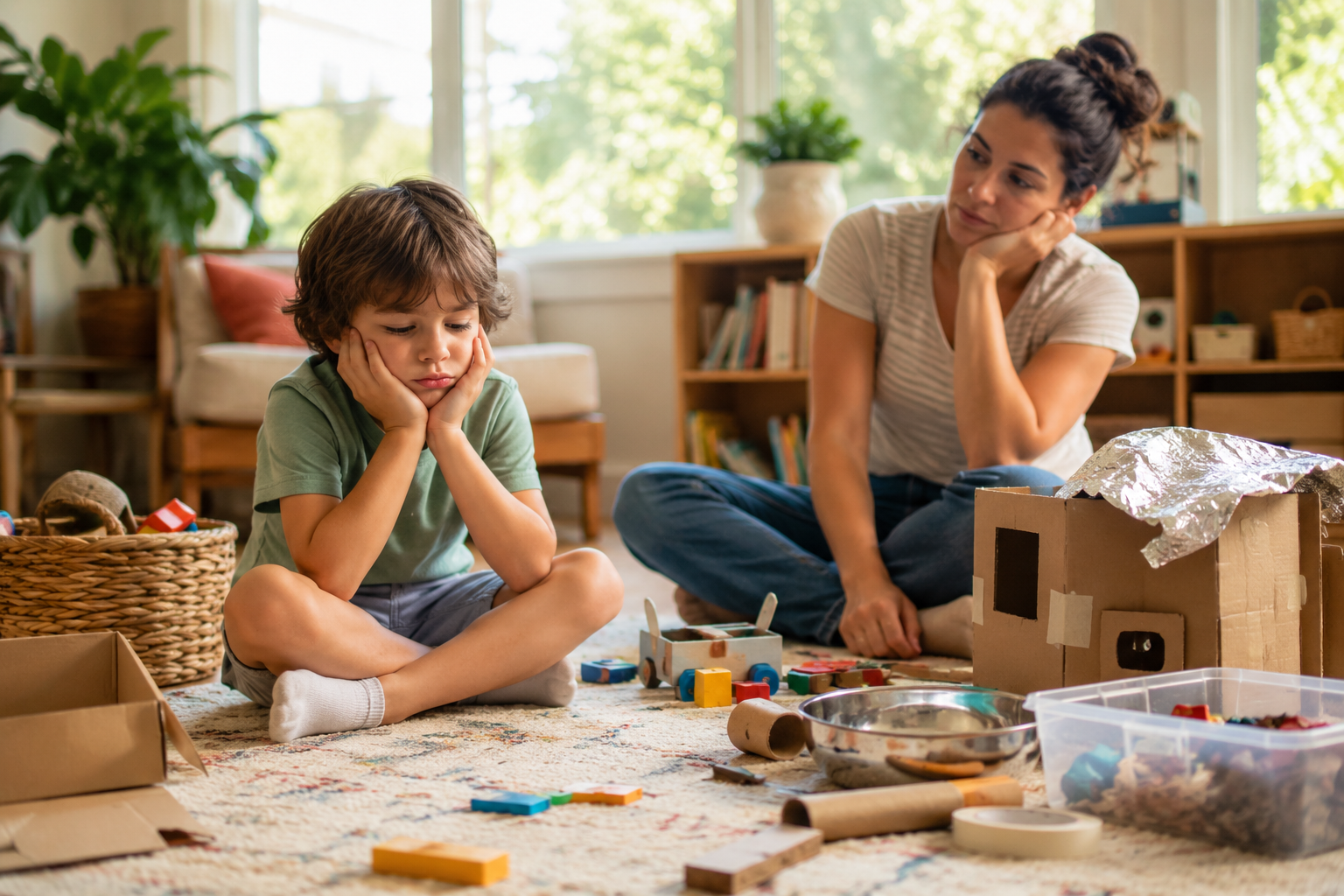
It’s 10am on a Wednesday in July. Your child has been awake for 2 hours, and it seems they have already played with every toy in the house, eaten breakfast, asked for many snacks, played outside, and asked you to take them to the zoo, the movies, and the park. You aim to minimize screen time; however, it’s starting to feel like the only way to keep them occupied long enough for you to get anything done is to hand them the tablet or turn on the TV. You’re quickly running out of fresh ideas and patience, and feeling overwhelmed by the long day ahead. Suddenly your child flops onto the floor and whines, “I’M BORED!!” Out of frustration, you respond, “How could you be bored!? Look at all the toys you have!”
As a classroom teacher, I often hear from caregivers about how to mitigate this scenario over the summer months. Although it might seem like a perfectly activity-filled calendar will offset boredom, filling the calendar with tons of activities can add another layer of stress. The ‘go, go, go” mentality can be exhausting for adults and kids alike! Below are some recommendations I share with families to get to the root of summer boredom, enrich imaginative play, and sustain their child’s engagement.
Get Curious: What’s your child’s schema for ‘bored?’
Language development suggests that children typically begin using words in speech before they can clearly define the word in isolation. Similarly, children acquire more nuanced language as they grow. You might notice your child using a few words to describe many different experiences. If the word ‘bored’ is something they hear in the media, at school with peers, or in books, they may begin using it before having a thorough understanding of what it means. Additionally, if they find that the word holds power with adults and elicits a strong reaction, they will be quick to exercise this power! When adults respond quickly to exclamations of “I’m bored!” they often end up in a circular dialogue that leaves everyone feeling frustrated.
Instead, I suggest caregivers get curious. Rather than jumping to solutions, ask your child questions AND truly listen to their responses. This communicates that you want to understand and that you know they are capable of insightful reflection (because they are!). Some questions I suggest are:
- What does bored mean to you?
- Can you tell me more about that?
- Have you been bored other times in your life? When?
- Where do you feel bored in your body?
- What’s the opposite of bored for you?
Questions like these are open-ended, meaning there are many ways for your child to respond and no right or wrong answers. Start with one and then follow up with additional questions to go deeper. Your goal is not to teach your child that bored does not mean what they think it means; rather, it’s to understand their experience so that you can dialogue from a place of mutuality. In the classroom, I commonly find that children use “bored” to describe these experiences:
- They are doing something independently and want peer and/or adult connection
- They are being asked to do work that feels challenging and/or confusing to them
- They are looking forward to what’s coming next and want it to be time for that event already
- They feel there is one right way to do or play something; when doing it wrong feels intimidating, describing the activity as ‘boring’ can be an avoidance tactic
- They are transitioning their brain from overstimulation via devices and screens to imaginative and/or tactile play that requires more energy
- They are tired
What types of toys or materials keep children inventing, imagining, and finding new possibilities?
I often advise parents to evaluate their children’s toys for open-endedness. When toys and materials are open-ended, there is no right or wrong way for a child to play with them. By nature, the items invite possibilities; there are endless options for what the toy can become in imaginative play and how it can be repurposed as play shifts. Children have agency to drive play and use materials to create their ideas, which ultimately leads to deeper, more sustained engagement. The best news is that many of the greatest open-ended materials are completely free! Here are some easy-to-acquire options to start with:
- Cardboard and tape – save cardboard boxes and provide children with masking tape and scissors – stay open and curious about the ideas they might build!
- Aluminum foil – give your kids a roll of aluminum foil, let them experiment with sculpture
- Loose parts play – collect found objects like bottle caps, acorns, cool rocks, dragon glass, fabric scraps, old pipe cleaners, buttons, etc. Store these in tackle boxes or small trays for building impermanent collages, additions to a dollhouse, or other miniature play
- Water and funnels – put a large tub of water outside with some old funnels and tubing, see what kinds of pathways children will create for pouring the water
- Kitchen items – instead of throwing old pans, spoons, and sifters away, keep them in a bucket for your child to play with outside in the dirt, by the water, or in the sandbox
If you are looking to invest in some open-ended play materials, PDX is rich with options for shopping:
- Scrap PDX – loose parts and found object play
- Goodwill – acquire used, sturdy, metal cooking supplies and storage options
- Spielwork Toys – prides itself on open-ended toys that invite child-led play
- Beanstalk Children’s Resale (Montavilla and Fremont) – offers high-quality toys at consignment prices
Stay in Touch!
If you learn more about your child’s understanding of boredom and/or discover an open-ended material that fuels your child’s engagement and imaginative play, I would love to hear from you! Comment below. Happy playing!