
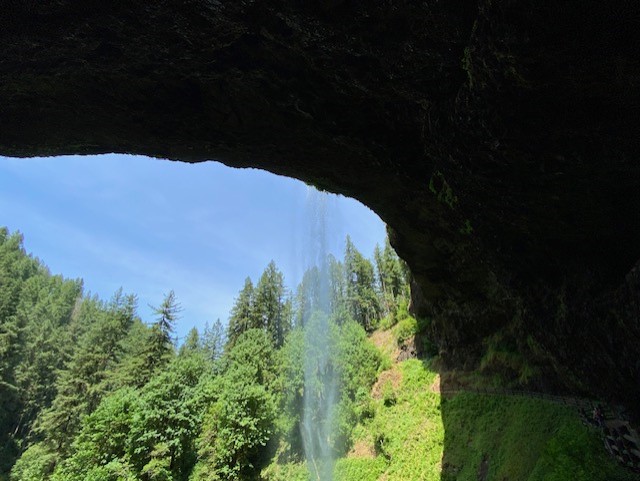
If you search the internet for “Best Oregon State Park,” Silver Falls comes up near the top on almost every list (except for the Guardian, but that’s a British publication, so I’ll cut them some slack). This is easy to understand if you’ve ever been there and seen it, but if you haven’t and you’re wondering what all the fuss is about, read on!
Silver Falls State Park is the state’s biggest park, with over 9,000 acres of temperate rainforest, tons of native Oregon plants and wildlife, historical sites, and, most importantly of all, ten massive waterfalls and numerous smaller ones. The waterfalls aren’t just massive; they’re beautiful. The geologic features of the park are similarly impressive. It’s all very Instagrammable.
The most important information you need is how to visit. The park straddles both sides of Hwy 214, about 15 miles southeast of Silverton in the Willamette Valley. From Salem, it’s about 20 to 25 miles east, depending on your starting point. Driving to the park is all but necessary, although private tours and guided trips sometimes include Silver Falls as part of a larger Willamette Valley outing. Some even combine the trip with wine-tasting, if that’s up your alley.
There’s camping at Silver Falls, including cabins for rent, but I will focus on single-day visits. This is a fee park, meaning parking now costs $10 per day for Oregon residents and $12 per day for out-of-state visitors. Unless, of course, you have an Oregon State Parks annual pass, which I highly recommend in my last post. Daily permits can be purchased at several trailheads, including South Falls, North Falls, North Canyon, and the campground registration booth. Bring exact change or a card, since the machines do not give change.
In my opinion, the best time to visit the falls is from May to late July. Snowmelt is still swelling Silver Creek, making the thunder of the falling water loud enough to feel in your feet as you stand behind North Falls looking out. Many native wildflowers are in bloom during this period. Different blooms will come and go all summer and fall, but this is the best stretch to see a large variety.
To see all the waterfalls in the park, follow the Trail of Ten Falls, officially listed as a 7.2-mile loop made up of the Canyon Trail and Rim Trail. You may see other estimates closer to 8 miles, depending on the specific connectors and routes people include. There are also shorter loops, such as the 2.6-mile Maple Ridge trail. There’s a much shorter loop to see South Falls, the second-highest cascade in the park (it’s one foot shorter than Double Falls, which is a longer hike and, while impressive, isn’t quite as awe-inspiring). Or walk along, finding waterfalls until you begin to get tired or cranky, then turn back.
One important note: pets and bicycles are not allowed on the Canyon Trail or on the trails leading into the canyon, including the Maple Ridge, Winter, and Twin Falls trails. Leashed pets are allowed on many other park trails, and Upper North Falls is a good option if you’re visiting with a dog. But if you want to take the classic waterfall route, leave the pup at home unless they’re very good at reading park rules and gracefully accepting disappointment.
For a much easier visit, go to South Falls. It’s frequented and has the most day-use parking. The hike to the falls from the parking area is less than half a mile, though there are a few different routes. South Falls is 177 feet high, and the hike is from the top down to the canyon below the cascade, where you can view the impressive fall of water from a bridge slightly downstream, meaning the elevation change on the trail is about 200 feet. An even shorter trip (with less elevation change) is to view the falls from one of the lookouts up top, hike down behind the falls, and then turn back.
The trail is steep in places, but I have seen people of varying mobility do it. There’s wheelchair access to a viewpoint above the falls, a great view, but the actual trail down is only navigable by walking. People sometimes take young kids in lightweight wagons, but it requires portaging down and back up a few flights of stairs. I remember riding in a backpack on my dad’s back to view the park when I was a little kid. For a more accessible trail option, the newer North Rim Trail near the North Canyon Day-Use Area offers an accessible route to a viewpoint of North Falls.
One of the best things about South Falls, and a few other falls in the park, is the trail leading behind the veil of the water. Softer basalt layers behind the cascades have eroded, creating a cave-like “rock shelter” with a handy and broad natural trail to walk on. Looking above at the shelf of rock overhead, lava tree molds are visible in the lava rock. From behind the falls, the Silver Creek canyon meanders downslope, calm again after rushing over the cliff and thundering into a deep pool. If you continue, the falls can be viewed from a bridge just past the pool into which the water cascades.
North Falls is the second easiest to access, with a much smaller day-use parking area. In my opinion, this one is superior to South Falls, albeit shorter. You can easily see Upper North and North Falls from the parking lot by hiking less than a mile, with less elevation gain. It’s not a loop trail, and some sections are steeper than at South Falls. The creek views above North Falls from the trail reveal some fantastic geologic features. The creek rushing through these rocks creates an attractive, dramatic set of rapids or mini-falls. Once at North Falls itself, the trail behind the cascade reveals a deeper rock shelter with worn sedimentary layers visible in between the basalt ones.
There is also a newer North Canyon Day-Use Area, which helps take some pressure off the South Falls side of the park. It has picnic tables, ADA-accessible restrooms, additional parking, and access to the North Rim Trail. If you’re visiting on a busy weekend, this can be a helpful place to know about.
If you have less than a couple of hours, or you have younger kids who can only handle so much, visiting just the North and South Falls is the best bet and is easily worth the trip and the day-use fee. To round off the visit, there’s a nature store and concessions selling snacks, beverages, sandwiches, gifts, and hiking essentials. The South Falls Lodge and Cafe are also in the South Falls area, and the larger Smith Creek Village area includes lodging, food, and event spaces.
As mentioned above, exploring the geology is another reason to visit the park. The formation of the falls over the millennia, combined with lava flows, created some unique rock formations and an impressive canyon. The park’s history is mostly visible in the historic buildings, from the earliest logging settlement on the site to the lodge, built by the Civilian Conservation Corps in the 1930s. These can mostly be found in the South Falls area. There’s also a ranch area with historic buildings and fabulous scenery to the east. On top of this, there’s the native plant life, including many little-known berries and trees dripping with moss. This is characteristic of a temperate rainforest, which receives 50 to 200 inches of precipitation annually.
The history of the area reaches much farther back than the park buildings, of course. The Silver Falls area is part of the ancestral homeland of the Kalapuya and Molalla people, whose history in the Willamette Valley long predates the park itself. Silver Falls officially opened as a state park in 1933. Still, its preservation was shaped by people such as Silverton photographer June Drake and Oregon state parks superintendent Samuel H. Boardman, both of whom helped make sure this place was protected rather than lost to logging and development.
Many other hikes lead to impressive vistas other than waterfalls. In addition, there are equestrian trails and some mountain bike trails. There’s even a fabulous wedding venue/retreat center that can be rented out.
There are also ongoing improvements on the north side of the park. The Oregon Parks and Recreation Department has been working on the North Gateway project, which includes a new visitor center near the north park entrance and related infrastructure improvements. The North Canyon trailhead and parking lot are already complete. The North Gateway Visitor Center is still in progress, with a projected grand opening in spring 2028. Basically, Silver Falls is already incredible, and the state is still working to improve the visitor experience. Fancy.
Full disclosure time: I grew up in Silverton and visited the park more times than I can count, so my opinion may be biased. I would argue that it’s not because I didn’t truly appreciate the falls (as we locals refer to them) until I was an adult. Most of my childhood memories are of a damp, cold, steep, muddy walk behind various waterfalls, usually swaddled in a raincoat that didn’t stand up to the sometimes sideways windblown clouds of mist coming off the cascade of water. It was way too familiar for me to appreciate the wonder.
I had no notion that most other places didn’t have ten falls so close together next door. I never realized that walking behind a waterfall was not the usual way to visit them. Or that the sheer amount of precipitation that fell from Western Oregon skies made them more massive and, therefore, more impressive.
I’ve now traveled enough to realize its uniqueness and become a “falls pusher.” I’m not embarrassed by that; if you visit, I’m sure you’ll understand why not.
I’m not sure when I began to appreciate the park. I remember when I was a senior in high school, my boyfriend’s older brother said his professor had visited national parks around the world and that he thought Silver Falls was one of the most beautiful spots on Earth. This startled me; I even doubted the guy had been to many great places, but I started paying more attention. My boyfriend and I hiked the entire Ten Falls Trail shortly after that, and I could see it if I squinted.
In my twenties, working for the Oregon Department of Forestry, part of my fire patrol area was Silver Falls, and I began to see how other people reacted to it, including people I worked with who hadn’t grown up a stone’s throw from the park. I really got it when I started going to parks in different parts of the world. More than once, I have hiked farther than I wanted to see some waterfalls and thought, “That’s it?” I tend not to make a significant effort to see other waterfalls. I mean, if it’s something like Niagara Falls (massive single falls and of geologic import), Angel Falls in Venezuela (the longest vertical drop in the world), or Victoria Falls on the border of Zimbabwe and Zambia (the largest in the world), I’d do it. In fact, Victoria Falls, or Mosi-oa-Tunya, is on my bucket list.
I thought it was cool, of course. Still, the overwhelming number of my childhood memories are of huddling in a raincoat, fingers nearly numb with cold, and many of them feature eating some half-soaked granola bar while standing up because there was no place dry enough to sit.
I also have significantly different memories, of course. I remember swimming in Silver Creek above North Falls in very, very cold water, although visitors should always follow current posted rules and stay within designated areas. Of course, most of our streams were very cold and still are. I remember seeing ant hills in the forests there that were as tall as me. I remember going to birthdays and family events there.
2022 was the 100th anniversary of Oregon’s state park system, which makes Silver Falls part of a much larger story. But for me, it still feels personal. It’s the place I grew up near, the place I took for granted, and the place I now push on people the way other people push their favorite restaurant.
If you go, wear traction-ready shoes, bring layers, expect mist, and check current park conditions before you leave. Then stand behind one of the waterfalls for a minute.
You’ll get it.
