If you have a kid who thinks dinosaurs are the coolest creatures ever to walk the Earth, Oregon might seem like an unlikely vacation destination. There are no herds of dinosaurs roaming the forests, and the state’s most famous fossil beds are better known for ancient mammals than dinosaur bones.
Yet, for a child fascinated by prehistoric life, Oregon is an extraordinary place to explore the deep past.
Across the state, families can discover fossils, explore ancient landscapes, learn how paleontologists piece together clues from millions of years ago, and get a glimpse of what Oregon looked like long before people called it home.
Start at the Thomas Condon Paleontology Center
The crown jewel is the John Day Fossil Beds National Monument, particularly the Thomas Condon Paleontology Center in the Sheep Rock Unit. This is the kind of place that can turn a child who likes dinosaurs into a kid who wants to become a paleontologist.
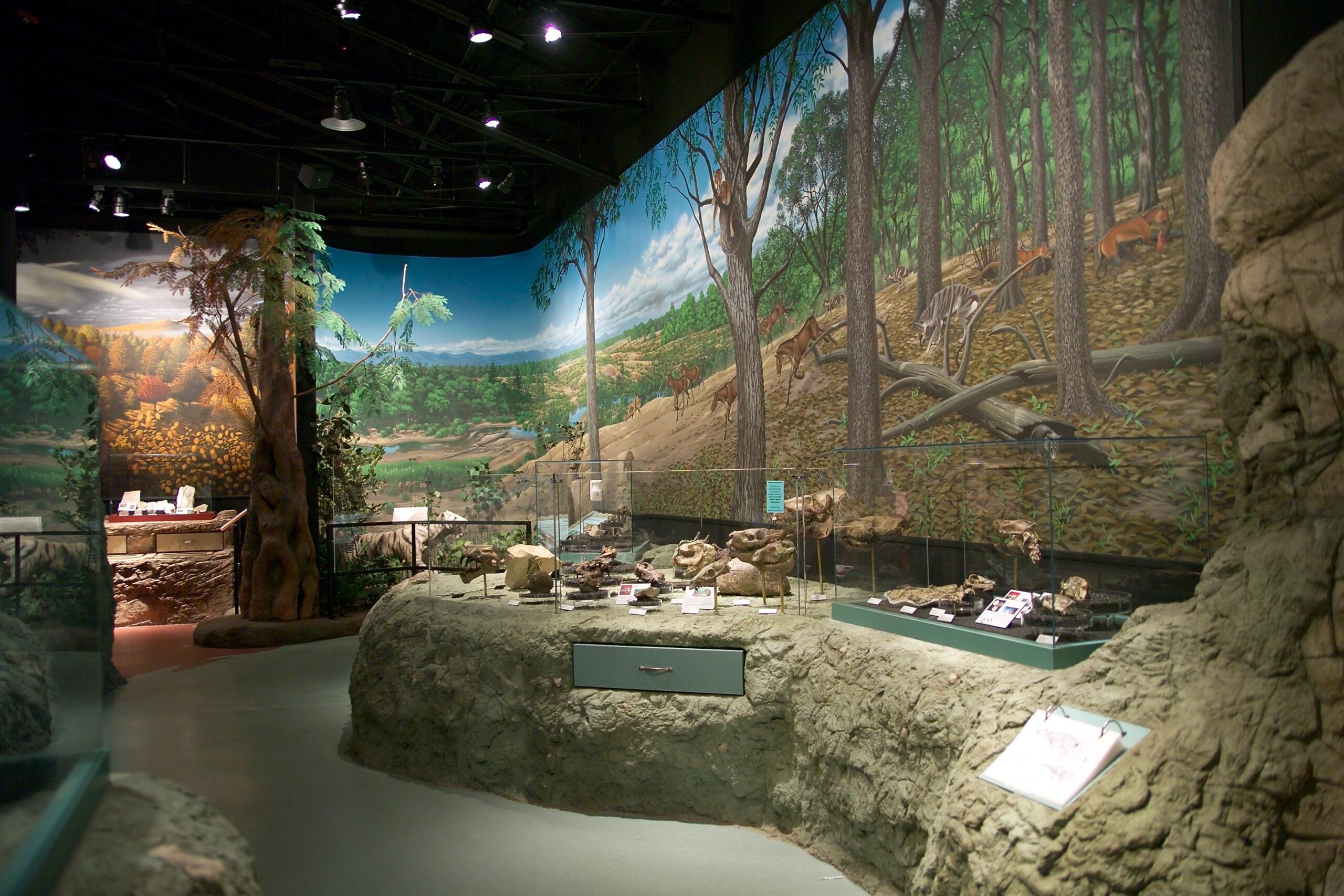
Inside, hundreds of fossil specimens help tell the story of millions of years of life in Oregon. Even better, the building doubles as a working research facility. Through windows, visitors can watch scientists studying fossils in laboratory and collections areas. Exhibits use fossils, murals, and other displays to reconstruct ancient environments and show how dramatically Oregon has changed over time.
There is also a Junior Ranger program, giving young visitors a reason to slow down, look closely, and actually engage with what they’re seeing.
For a dinosaur-loving child, that distinction is important. Instead of simply being told that a creature lived millions of years ago, kids get to see the actual evidence scientists use to figure out what ancient life was like.
Take the Prehistoric Story Outside
Perhaps the best reason Oregon works so well for prehistoric-minded kids is that the classroom doesn’t have four walls. John Day Fossil Beds National Monument encompasses more than 14,000 acres across three units: Clarno, Painted Hills, and Sheep Rock. Each offers a different glimpse into Oregon’s ancient past.
At the Clarno Unit, families can follow trails through striking rock formations and see fossil-bearing layers. The Painted Hills are perhaps the most visually dramatic, with colorful bands of rock creating a landscape that looks almost otherworldly. At Sheep Rock, the Blue Basin offers another opportunity to experience the geology and fossil history of the region.
As you explore, encourage your children to think like paleontologists: What did this landscape look like millions of years ago? What animals lived here? What did they eat? What clues have they left behind? How did the environment change?
Those questions can turn a hike into a prehistoric scavenger hunt, with the landscape itself becoming part of the lesson.
Just remember that John Day Fossil Beds is a place to observe and learn, not collect. Removing fossils from the monument is prohibited.
Discover What Came After the Dinosaurs
One of the most interesting things about Oregon’s fossil record is that it can introduce kids to a part of prehistoric history they may not know as well: the world that came after the dinosaurs.
The fossils at John Day largely date to the Age of Mammals, preserving an exceptionally long record of changing plants, animals, climates, and landscapes. Rather than encountering the familiar T. rex and Triceratops, children can learn about ancient horses, rhino-like mammals, and other creatures that lived millions of years after the non-avian dinosaurs disappeared.
It’s a natural way to expand a child’s understanding of prehistoric life. The story didn’t end when the dinosaurs disappeared. Earth continued to change, mammals diversified, climates shifted, and new species evolved.
For a child who loves dinosaurs, discovering what came before and after them can open up an entirely new world of curiosity.
Don’t Skip Eugene’s Museum of Natural and Cultural History
In Eugene, the Museum of Natural and Cultural History at the University of Oregon offers another way to connect kids with Oregon’s prehistoric past.
The museum explores Oregon’s natural and cultural history, with exhibits and educational programs involving geology, fossils, Ice Age animals, and the state’s deep history. It also offers family-oriented activities and programs.
It’s a good stop for families who want something more traditional and museum-based after spending time exploring Oregon’s fossil landscapes.
Get Curious About Rocks and Minerals
Another fun stop is the Rice Northwest Museum of Rocks & Minerals in Hillsboro. It isn’t a dinosaur museum, but that’s exactly why it belongs on the list.
Kids fascinated by fossils tend to become fascinated by the rocks surrounding those fossils. At Rice Northwest, families can explore an extensive collection of minerals, rocks, fossils, meteorites, and other geological specimens.
It may not be a dinosaur museum, but that’s exactly what makes it valuable. Kids can begin to understand that paleontology and geology go hand in hand. Fossils tell us about ancient life, while rocks and geological formations help scientists understand the environments in which those organisms lived.
Find Dinosaurs in the Forest
Of course, sometimes kids simply want to see a dinosaur.
For a more whimsical experience, families traveling along the southern Oregon coast can stop at Prehistoric Gardens, a longtime roadside attraction featuring life-size dinosaur replicas tucked among the coastal forest.
The setting makes the experience particularly fun for children. Instead of encountering dinosaurs inside a museum, they appear among the trees, creating the feeling of stumbling upon prehistoric creatures in the wild.
It’s a very different kind of educational experience, but one that can make a family road trip especially memorable.
Oregon’s Real Dinosaur Lesson
Oregon may not be the place to go if your child’s sole mission is to stand beneath a giant T. rex skeleton. But for families who want to explore the broader story of prehistoric life, the state offers something special.
Here, children can see real fossils, watch scientists at work, hike through ancient landscapes, explore geological formations, and ask questions about creatures and environments that vanished millions of years ago.
Most importantly, they can begin to understand that paleontology is about more than dinosaurs. It’s about curiosity, evidence, and piecing together clues to understand a world we can no longer see. And for a dinosaur-loving kid, there may be no better adventure than learning how to look at the world a little like a paleontologist.

Emily currently lives in Orange County, California after spending four years in Illinois and half a year teaching in Florence, Italy. She holds a B.A. in English Literature from Knox College and an M.A. in Counseling from the University of San Diego and has taught English to native speakers and ESL students for over three years. When she’s not working as a School Counselor or writing, she enjoys traveling the world, playing instruments, and blogging about Millennial experiences at Long Live the Twenties.