
Long before chimneys and stockings, before jingling bells and sleighs, there lived a kind man named Nicholas in a seaside town called Myra, in what is now Turkey.
Nicholas was not rich by accident—he was rich by choice. He believed that money was meant to be given away. Quietly, under the cover of night, he helped families who had nothing. Once, when a poor father feared his daughters would have no future, Nicholas slipped gold coins through the window. The coins landed in stockings drying by the fire. People began whispering about the mystery gift-giver.
When Nicholas grew old and passed from the world, the stories did not fade. They grew. Travelers carried his legend across Europe, where he became known as Saint Nicholas, the patron saint of children, kindness, and secret generosity. As centuries passed, Saint Nicholas changed with the lands that welcomed him.
In the snowy villages of the Netherlands, he became Sinterklaas, riding a white horse across rooftops. When Dutch families sailed to the New World, they brought him with them—along with his name. Sinterklaas slowly became Santa Claus.
In America, artists and writers dressed Santa in a red suit, gave him a round belly and a laugh like thunder, and placed him at the North Pole, where elves built toys and magic filled the air. Santa no longer walked alone; he flew.
Santa’s sleigh was pulled by strong, magical reindeer who could leap into the sky and race the wind. They were proud creatures, swift and steady, trusted to guide Santa through snowstorms and starlight. But one winter night, far from the North Pole, a small reindeer calf was born with something unusual. His nose glowed. Not red like a berry or an apple—but bright, like a lantern.
The other reindeer stared. They whispered. Some laughed. Others turned away. A glowing nose did not help fly—it was strange, and strange things are often misunderstood. The little reindeer was named Rudolph.
Rudolph learned to walk with his head lowered, trying to hide the light. But no matter how hard he tried, it shone through fog and snowfall, bright as hope: one Christmas Eve, a storm unlike any before rolled across the sky. Snow fell thick as clouds. Stars vanished. Even Santa, wise and prepared, stood still in the dark.
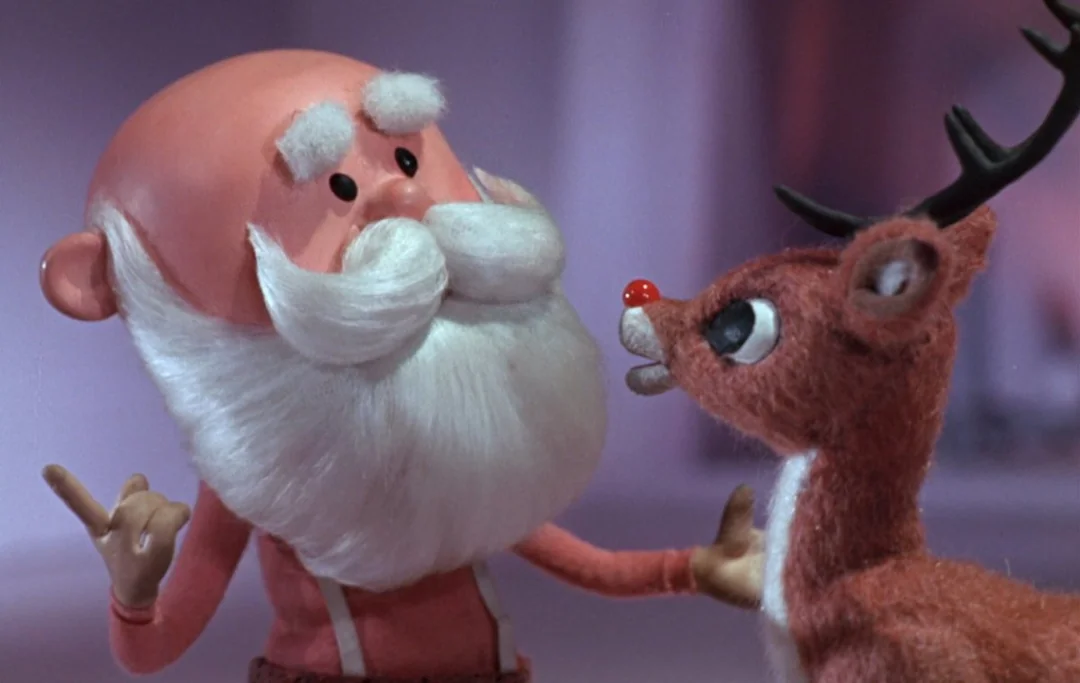
“How will we see the way?” Santa wondered aloud. That’s when he noticed a gentle glow in the shadows. Rudolph stepped forward, his nose lighting the snow at his feet. In that moment, Santa understood something Saint Nicholas had always known: What makes you different can be what saves the day.
Rudolph flew at the front of the sleigh, his glowing nose cutting through the storm like a guiding star. Homes were reached. Gifts were delivered. Christmas was saved.
And Rudolph was never laughed at again. From that night on, Santa and Rudolph became inseparable symbols of Christmas:
- Santa, born of genuine kindness and centuries of generosity
- Rudolph, a reminder that uniqueness is a gift, not a flaw
Together, they carry the same message across the world each winter:
Be kind.
Give quietly.
Believe in magic.
And never hide what makes you shine. And if you listen closely on a snowy Christmas Eve, you might hear a laugh, the jingle of bells, and see a small red light leading the way through the night.
