
Leonardo da Vinci was a genius who was hundreds of years ahead of his time, a symbol of perseverance who proved that tenacity can achieve the extraordinary.
Over the years, I have had the enormous privilege of studying under some of the world’s leading da Vinci scholars and of publishing several books and academic articles about him. As an artist, I was able to join the ranks of authorized Copyists for the Louvre, where I painted my own rendition of da Vinci’s Mona Lisa and Saint John the Baptist in the museum’s Paris galleries.
Even with my long history of studying Leonardo, I still come across new and inspiring things about him. One example is that he is the first to conceptualize a personal, ring-shaped lifebuoy (aka life preserver).
Most of da Vinci’s inventions were never built during his life. Instead, he chose to write down his inventions in his notebooks and use them as ideas to pitch for royal commissions. As for the lifebuoy ring, he left no written instructions, just a small drawing of a man in a body of water, with a circular lifebuoy around him. In this sketch, the figure’s head, arms, and shoulders are above water with the rest of his body submerged. This tiny drawing can be found in his notebooks under Paris Manuscript B, folio 81 v.
In other words, da Vinci was so brilliant that he invented the lifebuoy ring but didn’t think it was worthy enough to describe with written words.
Many of Leonardo’s inventions, including his lifebuoy ring, have been recreated many times over the years, often for museum exhibitions. However, it has never been built exclusively using Renaissance-era materials, methods, and techniques.
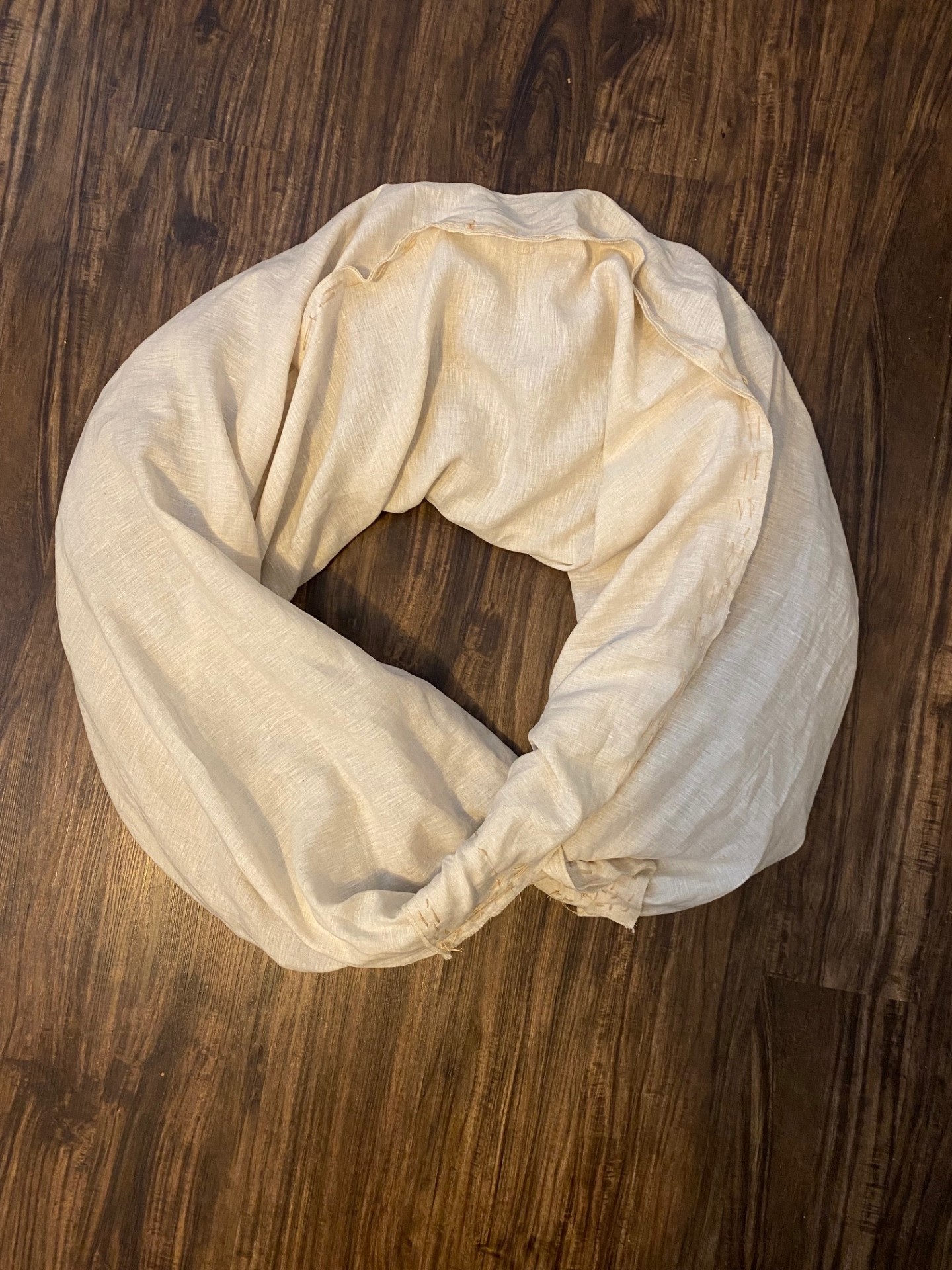
When I came across this obscure fact, my wife, Erin, and I decided to build it ourselves. We not only built da Vinci’s lifebuoy ring according to the sketch’s appearance, but also used period-appropriate materials consistent with what was available and referenced in his broader notebooks: Pure Linen, Linen Thread, Natural Cork, Beeswax, and a Steel Needle.
No machines, electricity, modern materials, chemicals, or anything from the post-Renaissance era were used in its construction.
After gathering the material, we hand-sewed the linen and stuffed it with natural cork that was graciously supplied to us by Furioso Vineyards. We then connected the ends, sewed them together, and brushed melted beeswax onto the linen to waterproof it.
Leonardo’s vision works beautifully.
This creation makes Erin and me the first people to document the successful, authentic construction of da Vinci’s lifebuoy ring by strictly using only period-specific materials, methods, and resources.
Several decades after Leonardo designed the lifebuoy ring, the Knights of Malta were the first to use a similar device to systematically rescue sailors who went overboard. While their lifebuoys were made of similar materials, a key difference was that the Knights’ design was static, whereas da Vinci’s was personalized to the person’s size. Over the next several hundred years, the lifebuoy ring was further perfected, especially as materials such as high-density polyethylene became available.
Regardless, the original conceptual design is owed to Leonardo da Vinci, who sketched down the idea sometime between 1485 and 1500.
For those interested in learning more about our experimental archeology project, you can check out our (very basic) blog by clicking here (davincilifebuoy.art.blog).
Below are simple instructions to build your own miniature da Vinci Lifebuoy Ring as an entertaining, family project
Materials Needed:
-Linen Cloth (about 12 to 18 inches long and 4-6 inches wide. Adjust size based on how big you want it)
-Linen Thread
-Melted Beeswax (note: this will be very hot, and not necessary for a simple display version)
-Wine Corks (around a dozen)
-Sewing Needle
Instructions:
Step 1: Lay linen cloth flat on table.
Step 2: Arrange the wine corks in a straight row down the center of the cloth, leaving about 1 inch of fabric free at each end.
Step 3: Fold the cloth lengthwise over your row of corks, then hand-sew the two long edges together to enclose them like a tube.
Step 4: Sew those ends together, then bend the tube into a ring shape and sew the two short ends together securely to close the circle.
Step 5: Carefully brush the entire linen surface with melted beeswax for waterproofing (beeswax is very hot when melted; use a brush and adult supervision). This step is optional for a simple display version. Allow time to cool and dry completely.
Step 6: Fill up a bowl with water and place the miniature lifebuoy ring on top.
Step 7: You have now created your own da Vinci Lifebuoy Ring! Enjoy your creation!
Important Note: Da Vinci’s Lifebuoy Ring is not intended to replace any standard life preserver. Always follow all official safety regulations.
Major thank you to Furioso Vineyards for sponsoring this experimental archeology adventure!

Alex is a devoted husband and father born and raised in Portland, Oregon. He is a professional artist, author, and advisor for both Yale and Harvard University’s arts departments. His books, ‘Selling Leonardo: The Art World’s Greatest Scandal’ and ‘Holy Ghost: Decoding Leonardo da Vinci’s Final Painting’ are available wherever books are sold.